
AI Smart Glasses Are Going Mainstream in 2026: What You Need to Know
For years, smart glasses were a punchline — remember Google Glass? But 2026 is shaping up to be the year the category finally clicks into place. Prescription AI smart glasses are launching, Samsung is teasing XR glasses for later this year, Apple is reportedly deep in the category, and Meta’s Ray-Ban glasses have already proven there is a real consumer market for always-on wearable AI. The question is no longer whether smart glasses will go mainstream. It’s how fast, and what it changes when they do.
What’s actually shipping right now
The market in early 2026 looks meaningfully different from even a year ago:
- Meta’s Ray-Ban Smart Glasses remain the mass-market benchmark — they sell at consumer prices, look like normal glasses, and support always-on voice AI with real-world awareness.
- Prescription AI smart glasses have launched, targeting everyday users who want discreet computing without having to wear them over contact lenses or regular frames. This is a major barrier removed.
- Samsung has publicly confirmed its XR glasses product, with an executive stating that “glasses, obviously, is one of” the next AI device categories — and hinting at a launch window later this year.
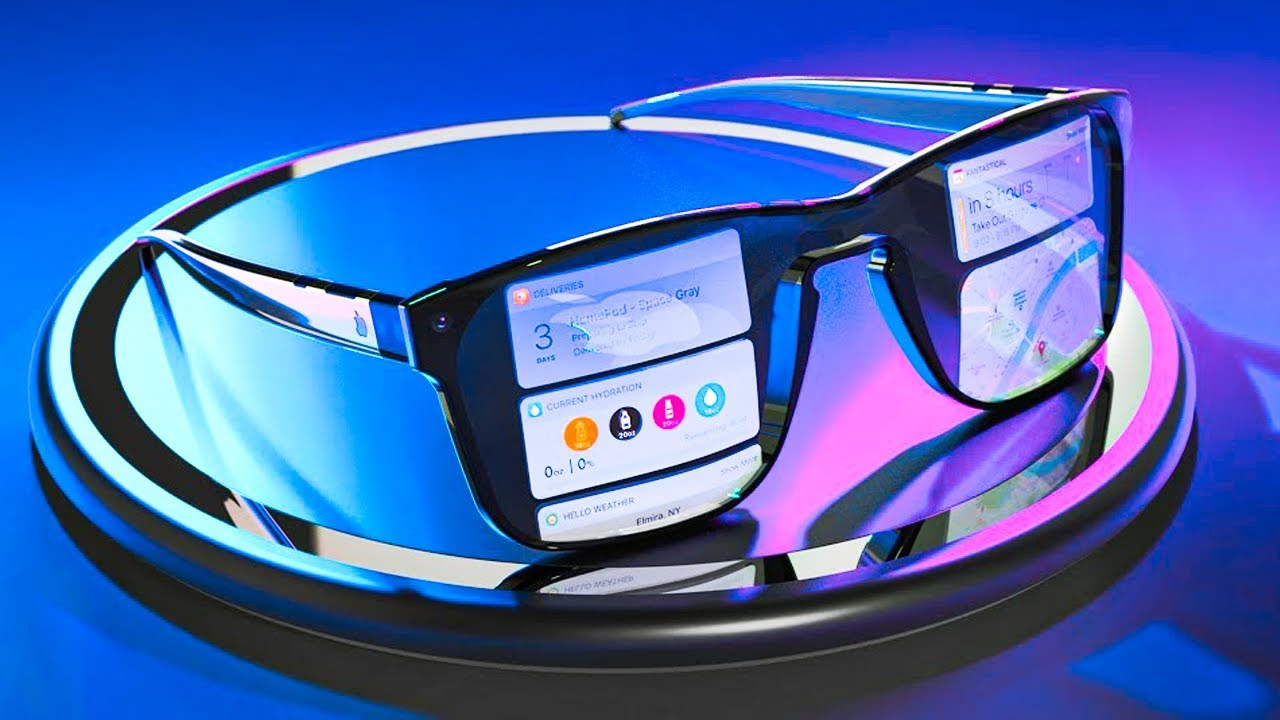
- Apple has reportedly been developing camera-equipped glasses as part of its broader wearables roadmap.
- Startups in the space are raising aggressively, focusing on enterprise use cases like logistics, field service, and hands-free workflow assistance.
Why edge AI is the key to making glasses work
One of the biggest shifts enabling the smart glasses moment is the move toward edge AI — running AI models locally on the device rather than routing everything to the cloud. This matters for glasses specifically because:
- Battery life is the defining constraint on wearables. Cloud calls burn radio and CPU. Local inference can be dramatically more power-efficient for common tasks.
- Privacy is a harder sell when everything you see and hear is streamed to a server. On-device processing is a much stronger story for users and regulators alike.
- Latency drops when the model runs locally. For a glasses interface that needs to respond to real-world context in near real-time, the difference between 50ms and 500ms is significant.
The competition between Big Tech players is increasingly about who owns the ambient computing layer — the always-present, context-aware interface that follows you through your day. Glasses are the most natural form factor for that vision.
The interface war beyond the phone
Apple CarPlay now supports voice-based ChatGPT interaction, Android Auto is pushing conversational AI integration, and glasses are adding a visual layer. What we’re watching is a race to own the interface that sits between humans and AI in every context — work, home, car, street.
This is a much bigger market and a much bigger competitive battle than any single device launch suggests. The phone was the dominant interface for 15 years. Whoever wins the ambient computing layer may hold that position for the next 15.
Real challenges that still need solving
The category is real, but it has genuine unsolved problems:
- Battery life remains the hardest constraint. Most current AI glasses need daily or more frequent charging.
- Social acceptance is unresolved. Cameras on glasses raise privacy concerns in public spaces, restaurants, and workplaces. Laws and social norms have not caught up with the hardware.
- Display quality — for glasses that try to show information visually, fitting a clear, readable display into a wearable form factor is still a significant engineering challenge.
- Heat management — running AI inference on a device that sits on your face has thermal limits that larger devices don’t face.
- Ecosystem fragmentation — different platforms, different app stores, different voice assistants. Users may face the same fragmentation headaches they had in the early smartwatch era.
What developers should watch
If you build software products, the smart glasses shift has practical implications:
- Voice-first interfaces will matter more — glasses interactions are primarily audio. Products that assume a screen and a keyboard are designing for yesterday’s interface.
- Context-aware features become valuable — glasses with cameras and real-world awareness create demand for apps that understand what the user is looking at. Computer vision + AI is a growing opportunity.
- Privacy-by-design is not optional — any product that integrates with wearable cameras or always-on microphones will face regulatory and user scrutiny. Build privacy in from the start.
- Cross-platform is the safe bet — betting your product exclusively on one glasses platform in 2026 is risky. Build for voice and ambient context first; the specific hardware will follow.
Final thoughts
Smart glasses in 2026 are what smartphones were in 2008: clunky in some ways, genuinely exciting in others, and clearly pointing toward something that will feel obvious in retrospect. The engineering challenges are real, but so is the momentum. Pay attention to this space — not because you need to build for glasses today, but because the interface assumptions it changes will affect every product you build in the next five years.
The ambient computing era is arriving. The glasses are just the most visible sign.